An MVP built in 3 months — cross-sold to an enterprise client and demonstrated live at two global media expos.
TL:DR
Ad Suite is a plug-and-play monetization layer designed for SaaS platforms — enabling businesses to unlock ad revenue without engineering overhead or compromising user experience. As Product Designer and team lead across a cross-functional team of 4, I designed the complete MVP in 3 months — from stakeholder research and information architecture through to final screens — building a foundation ready to scale into a full enterprise solution.
Project Background
SaaS businesses had a revenue ceiling — and subscriptions alone weren't breaking through it. The tools to monetize through ads existed, but every one of them was built for large-scale media networks. Too complex. Too heavy. Wrong audience.
I led a team of 4 designers to close that gap — designing an MVP Ad Suite from scratch in 3 months. A plug-and-play monetization layer built specifically for SaaS, with one goal: validate the concept fast enough to matter. The validation came not in a lab, but on the floor of IBC and NAB — two of the world's largest media technology expos — where the product was demonstrated live and cross-sold to an existing enterprise client.
Problem Statement
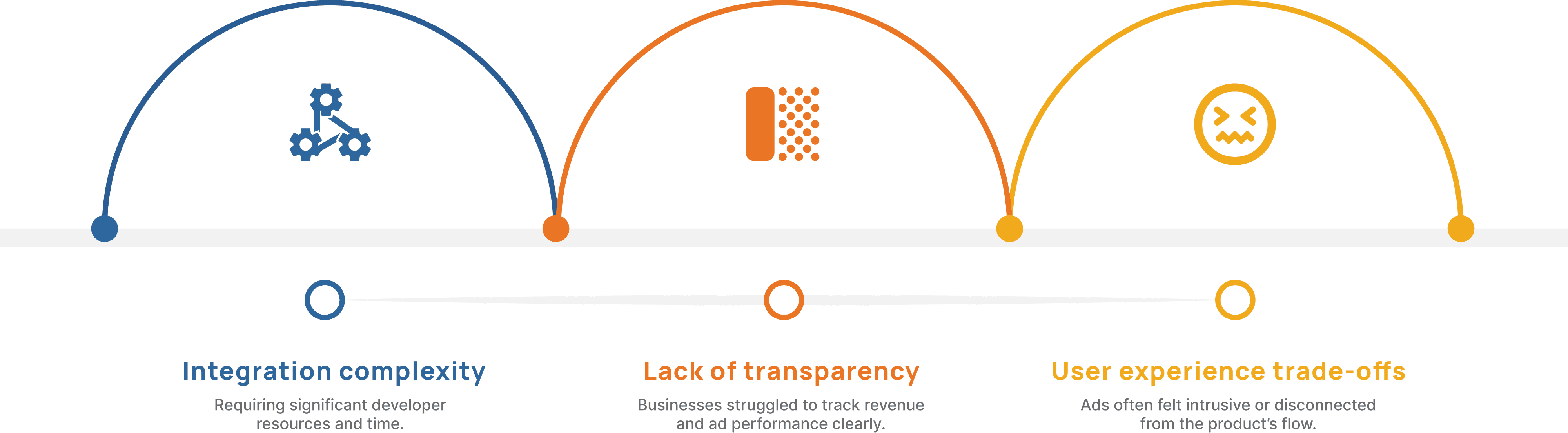
Existing ad platforms were designed for publishers and large-scale media networks — too complex and heavy for SaaS products. Key challenges included:
Design Goals
Four core goals guided every design decision:

Vision & Strategy
The vision was to deliver a minimum viable version fast enough to validate SaaS monetization before losing adoption opportunities to delay. By identifying the features that mattered most to publishers and advertisers and aligning with technical teams on feasibility from day one, we designed an MVP with no scope rework — efficient, usable, and built to scale.
Minimum Viable Product

Research & Discovery
To ground the design in real needs, I explored both competitor platforms and stakeholder expectations:
Competitor Benchmarking
Studied how platforms like Google Ad Manager and PubMatic handled ad serving.
Noted strengths (robust reporting, scalability) and weaknesses (complex setup, steep learning curve for SaaS).
Stakeholder Conversations
Businesses wanted new revenue without engineering overhead.
Developers stressed the need for a lightweight integration process.
Executives emphasized clarity in revenue visibility.
Information Architecture
To define the scope, I mapped out the core entities of the system and how they interact:

Ideation & Sketches

Initial Sketches

Final Screens

Outcome
The MVP was designed and delivered in 3 months — complete across campaign management, publisher dashboard, revenue reporting, and integration flow. Three distinct stakeholder types were designed for simultaneously, with zero scope rework.
Cross-sold to an existing enterprise client and demonstrated live at IBC and NAB — two of the world's largest media technology expos. For an MVP, that's the strongest validation signal possible
Future Projection
The first version was built to validate — and it did. Here's where it goes from here
Mobile Application: Real-time campaign and revenue visibility on the go — giving publishers and executives control from anywhere..
From MVP to Full-Scale Solution: The MVP proved the concept. Future iterations expand ad formats, deepen integration capabilities, and complete the journey from validation to enterprise platform.